

Seasoned disaster planners get their own houses in order before helping others plan for emergencies. Preparing your own personal emergency Go Bag is a good start. This first level of survival planning assures that you will have some valued personal items and won’t require immediate outside resources if you need to evacuate. You can go out the door in a hurry without making the normal and sometimes fatal blunders of people under extreme duress.

A Go Bag is not shelter-in-place preparation. A Go Bag is your custom-designed I’m-out-the-door-to-safety-right-now supply. Whether you call it a Go Bag, survival kit, emergency pack, shelter stay pack, or what I now call Oh-Oh-I-Forgot-To-Tell-My-Sister-How-To-Get-Ready-Before-Her-Family-Evacuated-The-Fire-That-Burned-13-Houses-In-Her-Neighborhood-So-Now-I’m-Telling-Everyone-Bag, preparing for a potential evacuation is good thinking.

Unfortunately, disasters don’t check your schedule for convenient times. During a voluntary or mandatory evacuation there just won’t be time to think through your choices calmly. You may not be interested in the complex workings of neurology and brain perception that are triggered during crisis. But if you are interested in emotional continuity management you know that people in crisis do really predictably crazy things. Survival behavior is often not a pretty sight.
You may find yourself in the path of a wildfire as the wind changes, a tanker truck or railroad car spilling random toxins, or a UFO invasion. Who knows what’s around the corner in our world today? When something unexpected happens, people naturally try to grab and protect belongings. This is normal behavior. Unfortunately, normal doesn’t cut it during a disaster! It is heart wrenching to see people run back into burning homes desperately trying to retrieve pets or valuables and come out with a phone book, an old pillow, a teaspoon, and a broken heart. Trust me on this. You don’t want to be one of those people. If you are someone who teaches others to be ready for emergencies, take your own pulse first. Are you ready? Today, long before you may be required to make an exit, make your 5-MINUTE GO BAG.
1) RIGHT NOW: Get your backpack
Obtain a backpack that you can carry. Purchased new, or old from a thrift store, a water-resistant backpack allows you to keep both hands free.
2) RIGHT NOW: Create your 5 Minute Go List
a) Go from room to room with a small notebook.
b) In your notebook list the one thing in each room that you would be able to carry in your backpack that if you lost you would suffer for the rest of your life (such as Grandma’s wedding ring, the only photo of your deceased cousin, a special book, a wedding photo).
c) List only one or two absolute treasures that fit in the Go Bag that you can grab as you are running through the house at breakneck speed with your list in hand because you have already pre-decided what you cannot live without. Make those critical decisions NOW. If you can put those precious items in the Go Bag now, all the better. If not, list them on the 5 Minute Go List.
3) RIGHT NOW:
a) Start your 5 Minute Go List with what you can manage alone. If you have help you can assign tasks. Examples:
-
- Turn off the gas and lights.
- Insulin in the refrigerator.
- Cell phone and flash drives with backup.
- All critical work-related contact numbers, priority data, or hard copy of emergency plans that you may need to work from an off-site location for a week.
- Lock doors.
- Grab the dog leash or put the cat in carrier that is by the door. (Most pet owners have a 5 Minute Go List/Plan for their beloved critters. I have seen chickens and cats inside cars at shelters, and horses tied to fences a mile away from homes with names and phone numbers painted on their backs.)
- Keys.
- Follow pre-arranged meeting plan with family.
- Make calls later.
b) Add all your phone numbers and email addresses as you might lose pre-programmed numbers and information. Remember, you only have 5 minutes. Call people AFTER you are out of your home and on your way to safety.
c) Include any originals or copies of valuable documents. Credit card numbers, Social Security cards, birth certificates, passports, banking information, a DVD of photos of personal items for insurance purposes, and an old utility bill to prove your home is (or was) where you think it is right now.
d) Stage your Go Bag in a very convenient location.
e) Now start on the Go Bags for all the other members of your family. (As in airline safety, once you have “your own oxygen mask in place, help those around you” thinking, you are ready and now can focus on others. Even a toddler can carry a tiny backpack with a blanket, a sweater, extra diapers, and a granola bar.)
4) WHEN YOU GET MORE TIME
a) Add other personal survival items, three-day (or more) supply of extra medications, old pair of glasses, portable radio, granola bars, flashlight, etc.
b) I recommend earplugs since you might have to sleep in a shelter with 4,000 of your new best friends. And breath mints. And deodorant.
c) One change of seasonally appropriate clothes (rotate items each season) is necessary.
d) Some cash in small bills for purchases and in case some disaster-exploitive jerk tries to sell you a bottle of water for $10 and you are really, really that thirsty! It happens.
Good job! Now you can zoom through your house and out the door in 5 minutes if you get the dreaded Midnight Knock On The Door. What you want in your Go Bag is up to you. It doesn’t have to be fancy or expensive. Once you have the basics in place you can improve the selection or upgrade anytime. Later, you can start a secondary Go Bag for the trunk of your car (keeping in mind that car trunks are not always secure, so don’t store anything valuable or critical there).
As time and budget allows you can continue to build and improve long-term emergency supplies. If you just added one or two items to your grocery list each time you shopped, you would soon have an ample emergency system in place.
But remember the Dr. Vali’s SPAM® Rule:
Store stuff you like.
If you don’t like SPAM® now… why would you want it during a disaster?
On the other hand, I live in Hawaii and SPAM® is what’s happening!
Wait… You Aren’t Done Yet!
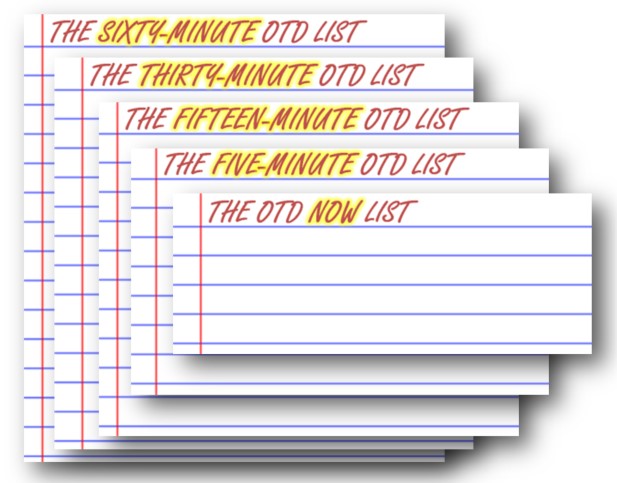 Grab your notebook and make the following entries:
- THE 15-MINUTE PLAN. Meaning you have 15 minutes or less to exit. Follow the same guidelines as above, only think what you could do with an extra ten minutes.
- THE 30-MINUTE PLAN. Meaning you have 30 minutes or less to exit. Follow the same guidelines as above, only think what you could do with an extra 25 minutes.
- THE 60-MINUTE PLAN. Meaning you have 60 minutes or less to exit.
- THE OFFICE GO BAG. Meaning you have to evacuate from your worksite. This bag should contain similar items as your personal Go Bag but should ALSO include critical workplace items, a hardcopy of your office disaster plan, critical flash drives, contact phone numbers, and emergency protocols.
Your Go Bag Checklist:
-
- Prepared my 5 Minute Go List.
- Started creating a Go Bag.
- Working on all my other emergency plans at my own pace.
- Feeling better prepared and getting on with my wonderful non-emergency-there-is-no-disaster-now life.
- Called my sister (or other loved ones) and got them started.
Article by Vali Hawkins Mitchell,
PhD, LMHC, CEAP
Originally published in the Disaster Recovery Journal (Fall, 2008) for disaster professionals and used here by the author's permission.
FOR EVEN MORE INFORMATION,
CLICK HERE TO DOWNLOAD DR. VALI'S 11-PAGE GO BAG ARTICLE
"Preparing for the Unexpected"
 Vali Hawkins Mitchell, PhD, LMHC, CEAP is the leading authority on emotional continuity management, author of “Emotional Terrors in the Workplace: Protecting Your Business’ Bottom Line,” “Dr. Vali’s Survival Guide: Tips for the Journey,” “#WeAreManyWomen: Many Voices,” and other books. She was chosen in 2020 by Pacific Business News as one of the Women Who Mean Business and is a General Partner of Employee Assistance of the Pacific based in Honolulu, Hawaii.
